
𝐓𝐇𝐄 𝟐𝟎𝟐𝟒 𝐓𝐎𝐔𝐑𝐈𝐒𝐌 𝐓𝐑𝐀𝐆𝐄𝐃𝐘 𝐎𝐅 𝐓𝐇𝐄 𝐏𝐇𝐈𝐋𝐈𝐏𝐏𝐈𝐍𝐄𝐒
The Philippines achieved warzone-level performance without warzone-level excuses.

In 2024, while Southeast Asia experienced a historic tourism boom with countries recording growth rates between 19% and 39%, the Philippines achieved the impossible: a catastrophic 26% tourism collapse that rivaled only Myanmar, a nation engulfed in civil war. This wasn’t a pandemic aftershock, a natural disaster, or a regional economic crisis. This was a self-inflicted wound born from diplomatic posturing, political miscalculation, and a stunning disregard for economic consequences. The 2024 Philippine tourism tragedy represents one of the most severe peacetime economic policy failures in modern Southeast Asian history.
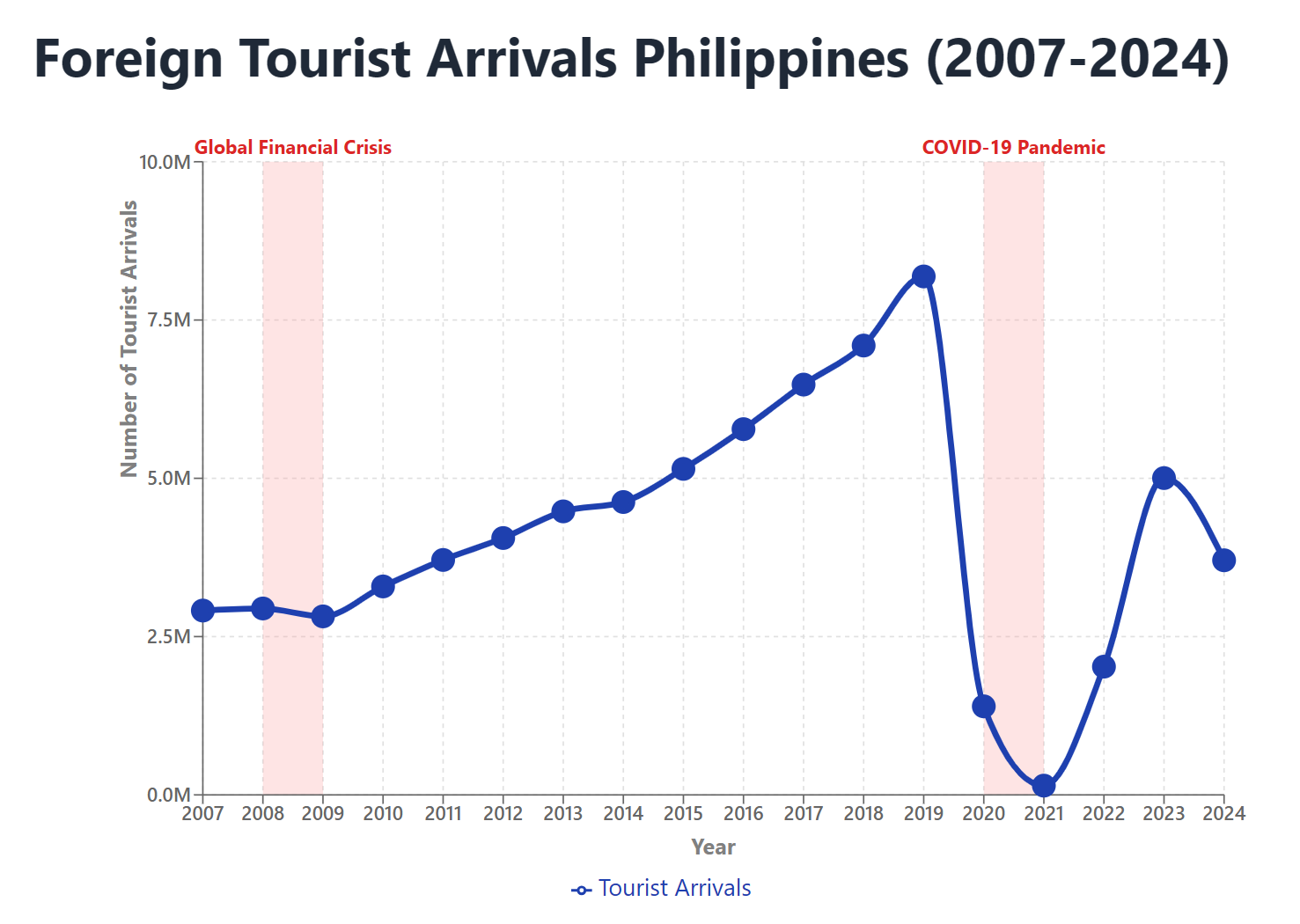
The numbers tell a devastating story. Foreign tourist arrivals plummeted from 5,003,475 in 2023 to just 3,705,268 in 2024—a loss of nearly 1.3 million visitors and approximately $2.6 billion in revenue. But behind these statistics lies a deeper tragedy: the systematic destruction of a sector that had spent two years clawing back from pandemic devastation, only to be crushed by geopolitical tensions that other countries managed to navigate successfully.
𝑻𝒉𝒆 𝑷𝒓𝒆-𝑷𝒂𝒏𝒅𝒆𝒎𝒊𝒄 𝑮𝒐𝒍𝒅𝒆𝒏 𝑬𝒓𝒂: 𝑾𝒉𝒂𝒕 𝑾𝒂𝒔 𝑳𝒐𝒔𝒕
To understand the magnitude of the 2024 disaster, one must first appreciate what the Philippines built—and lost. From 2007 to 2019, Philippine tourism was one of Asia’s great success stories. Foreign arrivals surged from 2.91 million to 8.19 million, representing a remarkable 181% growth over twelve years with a compound annual growth rate of 8.9%.
The momentum was accelerating. The final years before the pandemic showed explosive growth: 12.2% in 2017, 9.5% in 2018, and a stunning 15.4% in 2019. The Philippines was on track to reach 10 million tourists by 2020 or 2021, a milestone that would have cemented its position among Asia’s premier destinations. Tourism infrastructure expanded, international flight routes multiplied, and the country’s 7,641 islands became increasingly accessible to global travelers.
Then COVID-19 struck with unprecedented force. The pandemic crushed Philippine tourism more severely than almost any sector: from 8.19 million tourists in 2019, arrivals collapsed 83% to 1.40 million in 2020, then plummeted another 90% to just 146,098 in 2021—a staggering 98.2% decline from peak. Hotels shuttered, airlines withdrew routes, tour operators went bankrupt, and hundreds of thousands lost their livelihoods.
But disasters, even unprecedented ones, can be overcome. By 2022, as borders reopened, recovery began. Tourism arrivals reached 2.03 million—modest, but a 1,287% increase from 2021’s nadir. Then 2023 brought genuine hope: 5.00 million tourists, a 147% surge that reached 61% of pre-pandemic levels. The Philippines appeared to be following the regional recovery trajectory. Industry stakeholders invested in renovations, hired staff, and prepared for continued growth.
What happened next was unthinkable.
2024: 𝑻𝒉𝒆 𝒀𝒆𝒂𝒓 𝑬𝒗𝒆𝒓𝒚𝒕𝒉𝒊𝒏𝒈 𝑪𝒐𝒍𝒍𝒂𝒑𝒔𝒆𝒅
Instead of building on 2023’s momentum, Philippine tourism experienced a devastating reversal. Foreign arrivals crashed to 3.71 million, a 26% decline that erased two years of painful recovery. To comprehend how catastrophic this was, consider the broader context.
Southeast Asia in 2024 wasn’t struggling—it was booming. Every major destination experienced spectacular growth:
- Vietnam: +39%
- Malaysia: +31%
- Timor-Leste: +28%
- Thailand: +26.3%
- Laos: +25.3%
- Cambodia: +23%
- Singapore: +21.5%
- Indonesia: +19%
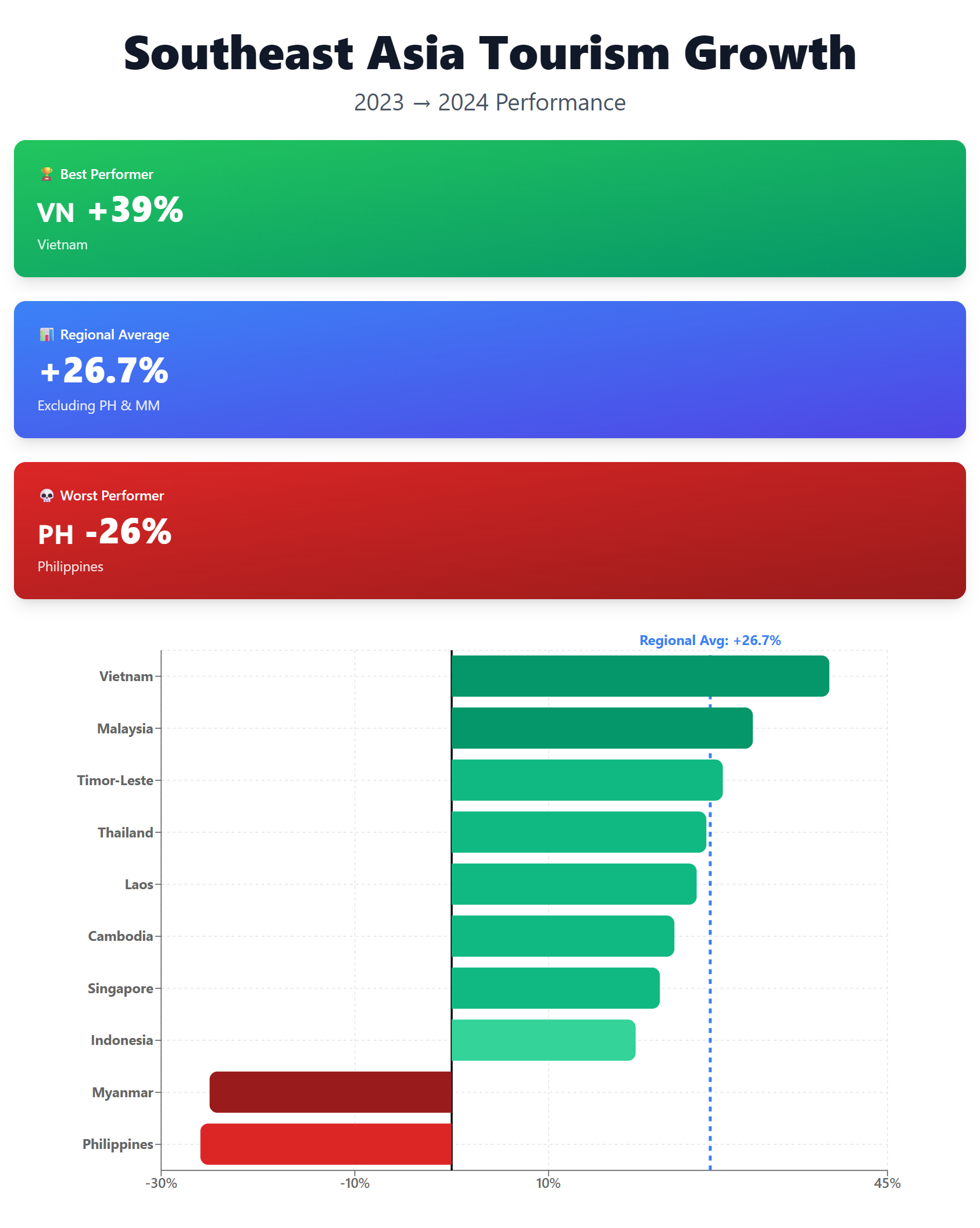
The regional average growth rate (excluding Myanmar and the Philippines) was +26.7%. This wasn’t a marginal uptick—this was a tourism explosion. The pent-up demand from pandemic restrictions, combined with aggressive marketing, improved infrastructure, and favorable visa policies, created perfect conditions for tourism revival across Southeast Asia.
And then there were the two outliers: Myanmar at -25% and the Philippines at -25.95%.
𝑻𝒉𝒆 𝑴𝒚𝒂𝒏𝒎𝒂𝒓 𝑪𝒐𝒎𝒑𝒂𝒓𝒊𝒔𝒐𝒏: 𝑨 𝑫𝒂𝒎𝒏𝒊𝒏𝒈 𝑰𝒏𝒅𝒊𝒄𝒕𝒎𝒆𝒏𝒕
Myanmar’s decline had obvious explanations: a military coup, ongoing civil war, ethnic cleansing allegations, and international sanctions. The country was, quite literally, a war zone. Yet the Philippines—a democracy at peace, without sanctions, blessed with world-class tourism assets—performed marginally worse. This comparison isn’t merely embarrassing; it’s devastating.
𝑻𝒉𝒆 𝑹𝒐𝒐𝒕 𝑪𝒂𝒖𝒔𝒆: 𝑨𝒏𝒕𝒊-𝑪𝒉𝒊𝒏𝒂 𝑺𝒆𝒏𝒕𝒊𝒎𝒆𝒏𝒕 𝒂𝒕 𝑷𝒆𝒂𝒌 𝑭𝒆𝒗𝒆𝒓
The elephant in the room cannot be ignored: 2024 marked the peak of anti-China sentiment in the Philippines. Territorial disputes in the South China Sea, always simmering, reached boiling point. Political rhetoric intensified. Media coverage amplified tensions. The message to potential tourists—particularly from China, historically one of the Philippines’ largest source markets—was unmistakable: you are not welcome here.
But Chinese tourists represented only part of the collapse. The broader damage came from perception: the Philippines appeared unstable, confrontational, and potentially dangerous. Asian tourists from neutral countries, seeking peaceful beach vacations, looked at the headlines and booked Thailand instead. European and American tourists, spoiled for choice in Southeast Asia, saw volatility and chose certainty elsewhere.
𝑻𝒉𝒆 𝑮𝒍𝒐𝒃𝒂𝒍 𝑭𝒊𝒏𝒂𝒏𝒄𝒊𝒂𝒍 𝑪𝒓𝒊𝒔𝒊𝒔 𝑪𝒐𝒎𝒑𝒂𝒓𝒊𝒔𝒐𝒏: 𝑨 𝑺𝒕𝒖𝒅𝒚 𝒊𝒏 𝑹𝒆𝒍𝒂𝒕𝒊𝒗𝒆 𝑫𝒊𝒔𝒂𝒔𝒕𝒆𝒓
Historical perspective illuminates the 2024 catastrophe. During the 2008-2009 Global Financial Crisis—arguably the worst economic shock since the Great Depression—Philippine tourism declined just 4.24%. The industry absorbed a worldwide recession, collapsing financial markets, and cratering consumer confidence with remarkable resilience. Recovery came immediately: 2010 saw 16.8% growth.
The 2024 decline, at 25.95%, was 6.1 times larger than the Global Financial Crisis impact. A diplomatic dispute inflicted more damage than global economic meltdown. This comparison reveals something profound: economic fundamentals proved more resilient than political choices. Markets recovered from financial crisis; they fled from geopolitical instability.
The 2008-2009 decline was external, unavoidable, and temporary. The 2024 decline was internal, preventable, and potentially permanent. The former affected everyone; the latter singled out the Philippines. The former created opportunities for recovery; the latter created competitive disadvantages that might never be overcome.
Even more embarrassing: countries with minimal tourist infrastructure outperformed the Philippines. Timor-Leste, one of Asia’s poorest nations with limited attractions and difficult accessibility, achieved 28% growth. Laos, landlocked and often overlooked, grew 25%. These aren’t tourism powerhouses with massive marketing budgets—they’re developing nations that simply maintained welcoming environments and avoided self-inflicted wounds.
The Philippines, blessed with extraordinary natural beauty, cultural richness, English-speaking population, and established tourism infrastructure, was crushed by destinations that should have been incomparable competitors. This isn’t about resources or geography—it’s about policy choices and their consequences.
𝑳𝒆𝒔𝒔𝒐𝒏𝒔 𝒇𝒐𝒓 𝑷𝒐𝒍𝒊𝒄𝒚 𝑴𝒂𝒌𝒆𝒓𝒔: 𝑾𝒉𝒆𝒏 𝑮𝒆𝒐𝒑𝒐𝒍𝒊𝒕𝒊𝒄𝒔 𝑻𝒓𝒖𝒎𝒑𝒔 𝑬𝒄𝒐𝒏𝒐𝒎𝒊𝒄𝒔
The 2024 Philippine tourism tragedy offers sobering lessons for policy makers globally about the costs of allowing geopolitical posturing to override economic realities.
𝘓𝘦𝘴𝘴𝘰𝘯 1: 𝘌𝘤𝘰𝘯𝘰𝘮𝘪𝘤 𝘊𝘰𝘴𝘵𝘴 𝘰𝘧 𝘋𝘪𝘱𝘭𝘰𝘮𝘢𝘵𝘪𝘤 𝘊𝘰𝘯𝘧𝘳𝘰𝘯𝘵𝘢𝘵𝘪𝘰𝘯 𝘈𝘳𝘦 𝘙𝘦𝘢𝘭 𝘢𝘯𝘥 𝘐𝘮𝘮𝘦𝘥𝘪𝘢𝘵𝘦
Territorial disputes and diplomatic tensions aren’t cost-free. Every aggressive statement, every military deployment, every heated exchange carries economic consequences. Tourism, particularly vulnerable to perception of instability, suffers first and most severely. Policy makers must consciously weigh whether diplomatic gains justify economic losses.
𝘓𝘦𝘴𝘴𝘰𝘯 2: 𝘙𝘦𝘨𝘪𝘰𝘯𝘢𝘭 𝘊𝘰𝘮𝘱𝘦𝘵𝘪𝘵𝘰𝘳𝘴 𝘌𝘹𝘱𝘭𝘰𝘪𝘵 𝘠𝘰𝘶𝘳 𝘞𝘦𝘢𝘬𝘯𝘦𝘴𝘴𝘦𝘴 𝘙𝘶𝘵𝘩𝘭𝘦𝘴𝘴𝘭𝘺
While the Philippines confronted China, Thailand, Vietnam, and Malaysia welcomed Chinese tourists and captured market share. Competitors don’t wait for you to recover—they actively exploit your vulnerabilities. Market share lost is often lost permanently.
𝘓𝘦𝘴𝘴𝘰𝘯 3: 𝘗𝘦𝘳𝘤𝘦𝘱𝘵𝘪𝘰𝘯 𝘔𝘢𝘵𝘵𝘦𝘳𝘴 𝘔𝘰𝘳𝘦 𝘛𝘩𝘢𝘯 𝘙𝘦𝘢𝘭𝘪𝘵𝘺
Actual risk to tourists was minimal—no tourist was harmed by South China Sea disputes. But perception of instability was sufficient to deter millions. Managing international perception requires sophisticated communication strategy, not just righteous position-taking.
𝘓𝘦𝘴𝘴𝘰𝘯 4: 𝘝𝘰𝘭𝘢𝘵𝘪𝘭𝘪𝘵𝘺 𝘋𝘦𝘴𝘵𝘳𝘰𝘺𝘴 𝘉𝘶𝘴𝘪𝘯𝘦𝘴𝘴 𝘊𝘰𝘯𝘧𝘪𝘥𝘦𝘯𝘤𝘦
The pandemic created unavoidable volatility; 2024 created policy-driven volatility. The latter is far more damaging because it signals that government prioritizes other objectives over economic stability. Businesses and investors flee such environments.
𝘓𝘦𝘴𝘴𝘰𝘯 5: 𝘙𝘦𝘤𝘰𝘷𝘦𝘳𝘺 𝘛𝘢𝘬𝘦𝘴 𝘠𝘦𝘢𝘳𝘴; 𝘋𝘦𝘴𝘵𝘳𝘶𝘤𝘵𝘪𝘰𝘯 𝘛𝘢𝘬𝘦𝘴 𝘔𝘰𝘯𝘵𝘩𝘴
Building tourism sector took the Philippines twelve years (2007-2019). Destroying it took one year (2023-2024). Reconstruction will take longer than original construction because damaged reputation must be overcome.
𝘓𝘦𝘴𝘴𝘰𝘯 6: 𝘚𝘮𝘢𝘭𝘭 𝘕𝘢𝘵𝘪𝘰𝘯𝘴 𝘊𝘢𝘯’𝘵 𝘈𝘧𝘧𝘰𝘳𝘥 𝘌𝘤𝘰𝘯𝘰𝘮𝘪𝘤 𝘚𝘦𝘭𝘧-𝘏𝘢𝘳𝘮
Large economies might absorb tourism collapse as acceptable cost of geopolitical positioning. The Philippines, a developing nation where millions depend on tourism income, cannot. Policy must account for economic vulnerability, not pretend it doesn’t exist.
𝑨 𝑷𝒓𝒆𝒗𝒆𝒏𝒕𝒂𝒃𝒍𝒆 𝑪𝒂𝒕𝒂𝒔𝒕𝒓𝒐𝒑𝒉𝒆
The 2024 Philippine tourism tragedy stands as one of the most severe peacetime economic policy failures in modern Southeast Asian history. In a year when regional tourism exploded—when Vietnam surged 39%, Malaysia 31%, and even Timor-Leste 28%—the Philippines collapsed 26%, performing worse than civil war-torn Myanmar and achieving the ignominious distinction of being the only peaceful democracy in the region to see tourism decline.
This wasn’t inevitable. The pandemic’s devastation was unavoidable; every country suffered. But the 2024 collapse was entirely preventable. It resulted from specific policy choices: allowing peak anti-China sentiment to drive away tourists and failing to develop alternative markets.
The 2024 tourism tragedy wasn’t an accident, an act of God, or an unavoidable consequence of global forces. It was the predictable result of policy choices that prioritized political posturing over economic welfare, diplomatic rhetoric over pragmatic management, and statistical manipulation over honest reform.
Future historians studying Philippine economic development will point to 2024 as an inflection point—the year a promising sector was sacrificed on the altar of geopolitical grandstanding, the year incompetent governance turned regional boom into national disaster, and the year the Philippines learned the hard way that in the modern global economy, perception is reality, volatility is poison, and diplomatic victories are pyrrhic if they leave your people impoverished.
This is the 2024 Tourism Tragedy of the Philippines: an entirely preventable catastrophe, a textbook case of policy failure, and a stark warning to other nations about the real costs of allowing political considerations to destroy economic sectors. The only question remaining is whether Philippine leaders will learn from this disaster—or whether the tragedy will continue into 2025 and beyond.
----
If you find value in what this blog does, please consider tipping via GCash - 09288956324 Buy me a Coffee to keep this blog sustainable and independent: https://www.buymeacoffee.com/srsasot
Dito makikita kng gaano kapalpak at kurakot ang pamahalaan ni romualdez(not marcos-mahina ksi itong isa at walang bayag inaasta asta lng ni martin)
Now, they're trying to woo the Chinese market again. They are trying to do it subtly and not make it look obvious and stupid.